Become an Incathlab member and receive full access to its content!

Registration Login

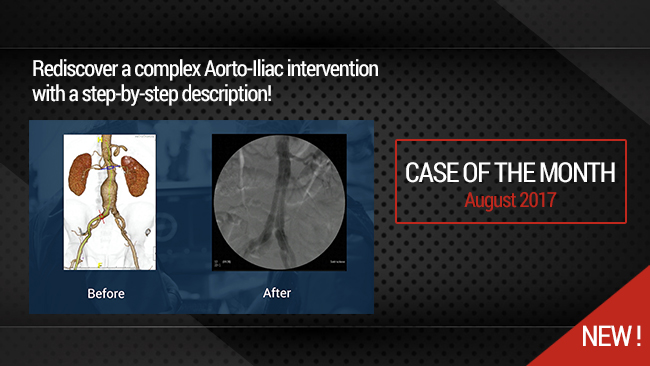
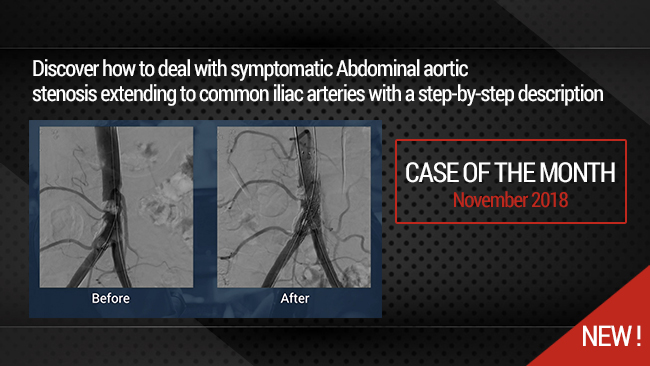
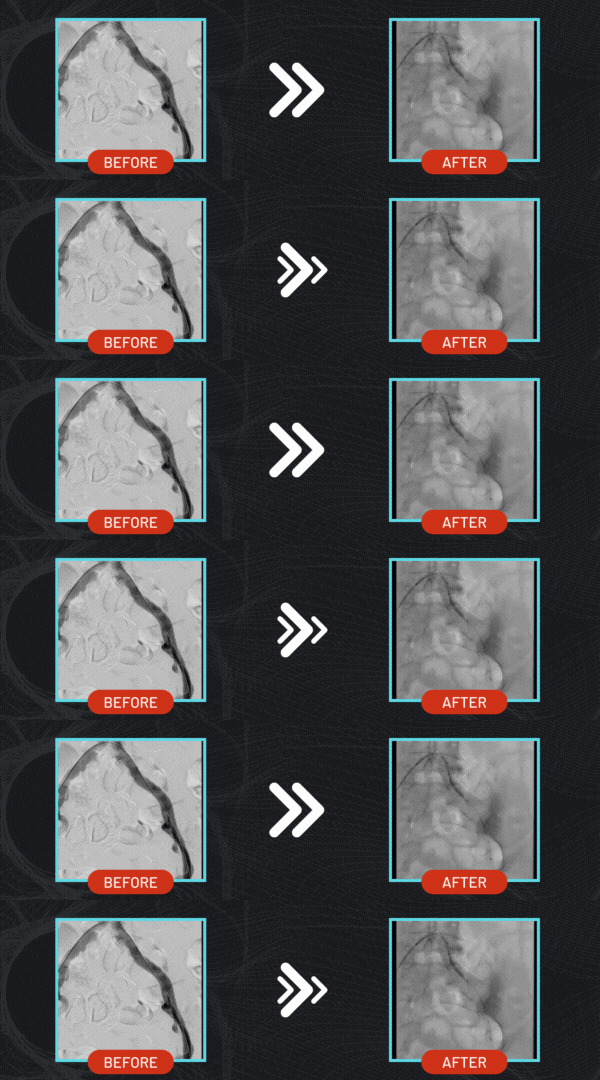
This video presents a clinical case of a 89-year-old female patient with significant aortoiliac disease, characterized by a calcific cauliflower-shaped stenosis in the left common iliac artery (LCIA) and left common femoral artery (LCFA) calcific occlusion treated with the Intravascular Lithotripsy System (Shockwave Medical).
Educational Objectives
- Understand the principles and mechanics of IVL, including how acoustic shockwaves disrupt calcific plaque while preserving surrounding vascular tissue.
- Identify the specific clinical scenarios in which intravascular lithotripsy is indicated, particularly in cases of heavily calcified lesions that may not respond well to traditional angioplasty.
- Explain the procedural steps involved in IVL, angioplasty and stenting for calcific stenosis.
Step-by-step procedure:
Using the Seldinger technique, a 7Fr sheath was inserted and crossover was performed.
A diagnostic catheter was inserted to perform a selective angiography of the aortoiliac region.
The angiography images were used to evaluate the extent of the disease and the morphology of the stenoses.
After angiographic evaluation of the lesions, a 0.014” guidewire was used in order to navigate through the stenoses.
After successfully passing the stenoses, the wire was exchanged to a 0.014” superstiff wire.
Appropriate intravascular lithotripsy (IVL) catheters designed for the vessel sizes were selected.
The catheters were connected to the Shockwave Medical lithotripsy generator.
The IVL catheters were carefully positioned to the site of the stenoses, ensuring proper positioning across the lesions.
The lithotripsy generator was activated to deliver a series of pulses of sonic waves. These shockwaves disrupted the calcific plaques while sparing the surrounding tissue.
Finally, an appropriately sized balloon-expandable stent was selected and placed based on the measured diameter of the LCIA and the characteristics of the stenosis.
Last update : 2024-10-29

Our Cases of the Month
The case of the month is a new way for our users to watch, learn, and share with incathlab. They can watch a video that highlights an innovative case and uses excellent pedagogical techniques, lear...

Suggestions

San Francisco : Thursday, June 18th 2026 from 11am to 12pm (GMT+2)
New York : Thursday, June 18th 2026 from 02pm to 03pm (GMT+2)
Buenos Aires : Thursday, June 18th 2026 from 03pm to 04pm (GMT+2)
Reykjavik : Thursday, June 18th 2026 from 06pm to 07pm (GMT+2)
London / Dublin : Thursday, June 18th 2026 from 07pm to 08pm (GMT+2)
Paris / Berlin : Thursday, June 18th 2026 from 08pm to 09pm (GMT+2)
Istanbul : Thursday, June 18th 2026 from 09pm to 10pm (GMT+2)
Moscou / Dubaï : Thursday, June 18th 2026 from 10pm to 11pm (GMT+2)
Bangkok : Friday, June 19th 2026 from 01am to 02am (GMT+2)
Shanghai : Friday, June 19th 2026 from 02am to 03am (GMT+2)
Tokyo : Friday, June 19th 2026 from 03am to 04am (GMT+2)
Sydney : Friday, June 19th 2026 from 05am to 06am (GMT+2)
Wellington : Friday, June 19th 2026 from 07am to 08am (GMT+2)